24 June 2009

I saw three deer

...at my campsite on San Juan today. Three blacktails: a doe and two fauns. The doe slinked out of the brush near where I was dripping coffee for breakfast. She looked at me with caution-- not as if she were afraid of me hurting her, but as if she didn't want to startle me, wake me up, disturb my breakfast.

I squatted and turned my head, making myself look small and unthreatening. She crept out of the brush, two spotted fawns scampering with excitement next to her.

It's the kind of thing I would have called my father to tell him about last summer-- and I almost tried to today. I had pulled his number up on my cell phone before my bleary, early-morning brain remembered.

It made me think of this poem by Donald Hall:

White Apples
when my father had been dead a week
I woke
with his voice in my ear
I sat up in bed
and held my breath
and stared at the pale closed door

white apples and the taste of stone

if he called again
I would put on my coat and galoshes

Tomorrow I leave on the first of six sea kayaking trips over the next couple of months. The trips are shorter this year, to my dismay, but should be fun all the same...

01 June 2009

Richmond Minor Eustis, Nov. 24, 1945- May 30 2009

This runs Tuesday and Wednesday in the Times-Pic. It was the most difficult thing I've had to write-- for many reasons.

I don't feel capable of writing much more about this right now. There is, of course, much more to say, but somehow it feels trivial to write about it in this medium. I may write more about my father's death later, but I doubt it will be here.

I am resigning myself to missing this man every day for the rest of my life.

Richmond Minor Eustis, a lawyer, died Saturday in his home in New Orleans after surviving cancer for nearly two years. He was 63.

The son of David Eustis and Molly Minor Eustis, Richmond Eustis was born in New Orleans and graduated from Isidore Newman School. He earned a bachelor’s degree in economics from the University of Virginia, where he was a member of Alpha Tau Omega fraternity, and he earned a JD from Tulane University Law School.

An expert in corporate and admiralty litigation, Eustis began practice at Phelps, Dunbar, then joined Monroe & Lemann, where he became a partner. He later founded the firm Eustis, O’Keefe & Gleason, where he practiced until shortly before his death. He was a member of the Maritime Institute and the Louisiana Bar Association, and was admitted to federal practice before the Fifth Circuit U.S. Court of Appeals and the U.S. Supreme Court.

His survivors include his wife of 38 years, Catherine BaƱos Eustis; two daughters, Julie Eustis Vaicius of New Orleans and Molly Minor Eustis of New York City; two sons, Richmond Minor Eustis, Jr. of Baton Rouge and Joshua Leeds Eustis of Chicago, IL; his brother David Leeds Eustis of New Orleans; his sister, Kate Eustis of Birmingham, AL; son-in-law, Christian Vaicius; two grandchildren, Lucy and James Vaicius, and more than a score of adoring nieces and nephews. His family and friends were gathered around him as he died.

Eustis served on the board of the Children’s Bureau and the New Orleans Board of Trade, and was an advisor to family-owned White Plantation. He was a member of the Inns of Court, the Sons of the Revolution, the Louisiana Club, and the Boston Club.

In addition to his legal work and his board work, Eustis enjoyed working outside in his yard or around his Lafourche Parish house. Blessed with what he liked to call “a trivial mind,” he was fond of the works of J.R.R. Tolkien, of punning humor, and of the dogs who flocked to him.

He also was one of a handful of people expert in the history, repair and maintenance of traditional Carnival flambeaux.

A funeral service will take place Friday at noon at Trinity Episcopal Church, 1329 Jackson Ave., in New Orleans—the church where as a boy Eustis served as acolyte. Burial will follow at Metairie Cemetery. Visitation will begin at 11 in the church.

In lieu of flowers, donations may be sent to one of the following groups: the Trinity Episcopal Church Medical Mission, 1329 Jackson Ave. 70130, the Kellermann Foundation/Bwindi Community Health Center—Uganda, P.O. Box 1901 Penn Valley, CA 95946, or the Delta Chapter of Alpha Tau Omega fraternity at the University of Virginia, P.O. Box 400314, Charlottesville, VA 22904.

19 January 2009

Humanism Ends With a Whimper

Yes, after 800 years of education as a process for the liberation of the soul, a new way of considering education has come to dominate: the training of students for standardized jobs. Contemplative thought is out, problem-solving and rote repetition of tasks is in.

(Of course, in a sense this is nothing new: education almost always serves the needs of the society footing the bill for it. If you think education isn't working or that the schools are crappy, it's not a bad idea to start asking why we have chosen that such should be the case.)

Anyway, here's Stanley Fish on a new book by a student of his, Frank Donoghue (called, incidentally The Last Professors: The Corporate University and the Fate of the Humanities):
How has this happened? According to Donoghue, it’s been happening for a long time, at least since 1891, when Andrew Carnegie congratulated the graduates of the Pierce College of Business for being “ fully occupied in obtaining a knowledge of shorthand and typewriting” rather than wasting time “upon dead languages.”

Industrialist Richard Teller Crane was even more pointed in his 1911 dismissal of what humanists call the “life of the mind.” No one who has “a taste for literature has the right to be happy” because “the only men entitled to happiness . . . are those who are useful.”

The opposition between this view and the view held by the heirs of Matthew Arnold’s conviction that poetry will save us could not be more stark. But Donoghue counsels us not to think that the two visions are locked in a struggle whose outcome is uncertain. One vision, rooted in an “ethic of productivity” and efficiency, has, he tells us, already won the day; and the proof is that in the very colleges and universities where the life of the mind is routinely celebrated, the material conditions of the workplace are configured by the business model that scorns it.

The best evidence for this is the shrinking number of tenured and tenure-track faculty and the corresponding rise of adjuncts, part-timers more akin to itinerant workers than to embedded professionals.
I've ranted here before about the ascendancy of the corporate model for increasingly large shares of our world. By this I don't mean the corporate takeover and "privatization" of more and more of economic life. Rather, I'm referring to the adoption of an efficiency-obsessed, profit-fetishizing, model for non-business pursuits such as law, medicine, and yes, academia. Market pressures make an operation leaner; it's true. More efficient, sure. But one loses the point of pursuing law, medicine, or deep study of a subject. It's just not the right model for these things (or many others). I'm not going into it further here.

The main purpose of some (though increasingly few) pursuits is not the generation of profit.

So, even those who hoped to escape the god of efficiency by going into medicine or, say comparative literature, are reduced to "service delivery" cogs in an enormous profit-generating machine. And the profits are generated, no doubt there. But if you can deliver service without the doctor-- or with only 4 minutes of a doctor's time, or by eliminating tenured professors in favor of podcast lectures-- then that's efficient. But medicine is harmed. As is education. Fish and his student are right. I'm hoping against hope I don't end up in a miserable adjunct job for the rest of my life. Increasingly it's the kind of hope one generates on buying a Powerball ticket.

To repurpose a quote by Gov. Edwin Edwards: "A Ph.D. program is tax on people who are bad at math."

More from Fish
:
The for-profit university is the logical end of a shift from a model of education centered in an individual professor who delivers insight and inspiration to a model that begins and ends with the imperative to deliver the information and skills necessary to gain employment.

In this latter model , the mode of delivery – a disc, a computer screen, a video hook-up – doesn’t matter so long as delivery occurs. Insofar as there are real-life faculty in the picture, their credentials and publications (if they have any) are beside the point, for they are just “delivery people.”
...

Those ideas have now triumphed (Carnegie and Crane are victorious), and this means, Donoghue concludes, “that all fields deemed impractical, such as philosophy, art history, and literature, will henceforth face a constant danger of being deemed unnecessary.” And as a corollary “professors will come to be seen by everyone (not just those outside the academy) as unaffordable anomalies.”
In other news: in an effort to save the state a couple of bucks, Gov. Jindal has proposed cutting health care (never medicine, now) and higher education. One of the departments on the chopping block?

Mine.

06 December 2007

John Wesley Powell I am Not, But Still...


Get this: if you're a boater-- I mean a real boater, not someone who hires raft guides-- it's next to impossible to get on the Colorado River through the Grand Canyon. To do it, you have to get a permit from the National Park Service- and the vast majority of permits go to the commercial outfitters, which charge thousands of bucks for the 15-day trip. The demand for the remaining "private boater" permits is so huge that the park service can charge applicants $25 just to have the chance to enter the lottery in hopes that they MIGHT get a permit that year.

I've never gotten a permit. Until yesterday. (That sound you heard was all my kayaking buddies scrambling for the cellphones to see if I might have space for one more. Of course I do. It's a full permit.)

It's a terrific opportunity, of course. A once-in-a-lifetime deal. And considering the academic work I'm doing on Powell's journals, it's right in line with my studies as well.

But here's the problem: I got the permit in the secondary lottery, which raffles off the slots that others have canceled on. I have to tell the park service by Dec. 10 if I want my launch date-- which entails dropping a deposit of $400. And the launch date is Jan. 14.

The first day of class for the spring semester at LSU.

I've committed to teach World Lit (1650-present) in the spring. (Not exciting to everyone, I know, but I'm pretty psyched about it. My syllabus rocks, if I do say so myself-- devised over a pious beer or two with my buddy Tom, who is teaching a section of the same course for the English department.) So, yes, I could beg someone (most likely Tom) to cover my class for the first two weeks-- after all the first week is just adding and dropping-- and MLK day accounts for one of the classes, so I wouldn't be missing much.

I could do this. Maybe. It would be kind of a rush and a stretch, but I could do it.

Except that the first couple of classes are crucial for setting the tone for the rest of the semester. And if I bail on the first two weeks, it's not a great way to get started. It's not exactly a display of commitment to my current line of work. My track record for making any kind of commitment at all over the past five years or so has not been so hot. I'd like to remedy that when I can.

Except that it's the GRAND CANYON. And just this once. Maybe. My department chair/committee chair (also a bit of an outdoor devotee) said he would understand...

I hate when "outdoor guy Richmond" decides to tangle with "academic guy Richmond." I like both of those guys and want them to get along. (And besides, Academic Richmond is kind of a wuss...)

So I have three days or so to figure this out and get a team together.

That's if I go.

If I don't, back into the lottery I go, to wait for another chance.

And wait.

And wait.

And wait.

20 April 2007

Steady Now

In June of 2005 I was in the Salt Lake City airport en route to a summer guiding job in Wyoming. Out of some odd impulse, I picked up The New Yorker. It was odd, in that I tend to stay away from The New Yorker. Whenever I have had a subscription, the issues pile up and keep coming until they form a paper testament to everything I will never accomplish in my life-- chief among them, keeping up with the damn New Yorker.

So I stay away from it. In general. Except for that time. That time I found a poem in it by Eamon Grennan. I liked the poem so much I tore out the little corner it ran on, folded it up into quadrants, and jammed it into the handy pocket in the back of the Moleskine notebook I use as journal and wallet.

I carried it around all summer, vaguely aware it was there. Then I found it again one morning in early September 2005, when I was exhausted and sad about what had happenen to my city and to my friends and family and neighbors.

I saw the words differently then. But I still thought it was a good poem. And reading it this morning, I still think it's a very good poem. So here it is.
Steady Now

Although things vanish, are what mark our vanishing,
we still hold on to them-ballast against the updraft
of oblivion-as I hold on to this umbrella in a world of rain,

of heavy wet greens and grays dissolving into a new
atmosphere, a sort of underwater dulled electric glow
off everything, the air itself drowning in it, breath

thickening, growing mold. Yesterday I felt the smell
of grass greeting me as across a great distance, trying
to tell me some good thing in an underglaze of memory,

some forgotten summer trying to speak its piece. It is
the way of things and it never stops, never calls a halt-
this knocking and dismantling, this uprooting, cutting out

and digging down, so tall oaks and honey locusts are
laid low and drop to earth like felled cattle, shaking
the ground we've taken a stand on as if it were a steady

establishment, a rock of ages to outface ruin itself, not
the provisional slippery dissolving dissolute thing it is-
which we have against all evidence set our hearts on.

31 March 2006

The Forbidden Bookshelf


These are some of the books I am to have committed to memory enough to handle an exam on them by the end of next week or so. I'm not allowed to refer to them during my exam, of course. Hence-- the "forbidden bookshelf." It also sounds so... daunting. There are others, of course, but they're in the library. I can't buy everything I'm supposed to read. I'd be totally broke.

After a 20 minute meeting or so this week, my committee and I have decided that I will be examined for my Masters in passing April 25. What this means in practical terms is that I have to have the written answers to my exam questions in to the committee members 10-14 days earlier. Which means I will be receiving those questions either next week, during spring break, or immediately after it. This makes me very, very nervous. There are an awful lot of books on my list, and I'm expected to know them all.

Here's how the process works: I have three areas of knowledge on which I'm to be examined-- in my case it's Southern U.S. Literature, The Caribbean and Aesthetics. On a determined day at a determined time, the committee chair will email me the first question. I will not know in advance which of the three areas it is to cover. I have three hours to answer and email it back (thus giving it a time-stamp within three hours). Then the next day I receive question two, and the same gig follows. Ten-15 days later, I am examined on my answers to the written questions, and then on the third field which the questions didn't cover.

Whew. I'm trying to arrange the subjects thematically, so that whatever I'm asked, I'll be able to respond. I have a sort of continuum going with Cesaire-Glissant-Walcott-Ferrer-Harris-Chestnutt-Morrison-Faulkner-Marquez-Cable-Kant-Schiller-Hegel. I think that with a few themes I'm not going to set out here, I may have found a way to field most questions. Did I mention that I'm not allowed to consult books or notes during the exam? That I have to know this material well enough to call it up on command?

At least it will be done April 25, at which point I plan a long drinking binge.

21 March 2006

God Help Us

Recovery workers are still finding bodies in the debris-strewn wasteland of the Lower Ninth Ward. Here's a quote from the article in today's Times Picayune:
Glynn said it is hard to tell how long the recovery efforts will take. Recovery workers have to be painstaking as they clear away sludge and debris in a house or a debris pile so that human remains aren't overlooked.

"A lot of people don't realize, they are surprised that we're still finding bodies -- the first workers who showed up after the storm were rescue workers, and they really were looking for survivors, not dead people. And they didn't have a list like we do of missing people, and it was so difficult to get through these houses sometimes, they just had to call and listen for a reply. You see how many times you see they wrote NE on the houses -- that means no entry. So no, it doesn't surprise me that we are finding people still."
It wouldn't surprise me if we never find the remains of all the people killed in the floods. It's information like this that tends to stun my friends from out of town, who don't really realize just how bad it still is in New Orleans.

16 March 2006

Ow. Ow. OW!!


Here's the situation: tired after making special allowances for slacker students to take their spoken exams, biker races to relaxing session on climbing wall. A little indoor bouldering, a little goofing off, and all will be right with the world.

It's been raining, and the pavement is wet. As the biker nears the sharp left turn he has to make to get to the rec, he notices oblivious young coed opening door of luxury vehicle. To dodge a dooring, he turns early, but not unmanagably so. He cants the bike left. Big, but not unmanagable.

Did I mention it had been raining all day? Did I mention he was on the wet pavement? Oh, and did I mention his bike was rocking the touring slicks that make his daily ride such a pleasure?

He makes the turn. His wheels make deep swooshing sound-- like sliding through wet snow. Biker makes graceful, swift, 30-foot slide on pavement. He pops up, like a football receiver who just took a bone-jarring tackle. He assures the gape-jawed coed that he's just fine, thanks for asking. And he goes into the building for his climb.

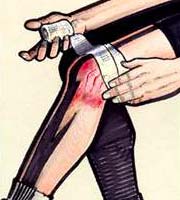
But biker has road rash. He should write ROAD RASH. It runs from left knee halfway down the front of left shin. Also, biker has unshaven, hairy, Chewbacca-style legs. Gravel and dirt and hair all up in that road rash, which required extensive cleaning with brush and tweezers.

OW!

And let me reiterate..

OW!
OW!
OW!

MOTHER@#$%!!!!

Leg now debrided (as well as I could without convincing the neighbors I'm into some kind of self-torture), swabbed in Povidone and bandaged up with Telfa pads.

I will now drink the half-bottle of Ravenswood zin. It will help me feel better while I watch basketball. And it is the delicious. (Yes, I've already started...)

And I will whimper softly to myself.

Now, just my pride hurts. I HATE falling on my bike.